
NovaLiftGarage Doors (954) 758-9013
Garage door repair

Garage Door Opener Repair

Garage door opener repair covers the motor, the drive, the remotes and keypads, and the safety sensors near the floor. NovaLift Garage Doors fixes openers that hum, stall, ignore the remote or send the door back up, in Hollywood and across South Florida.

Opener running but the door won't move? Stop pressing the button. If a spring or cable has failed, the opener is fighting the full weight of the door, and that can damage it.

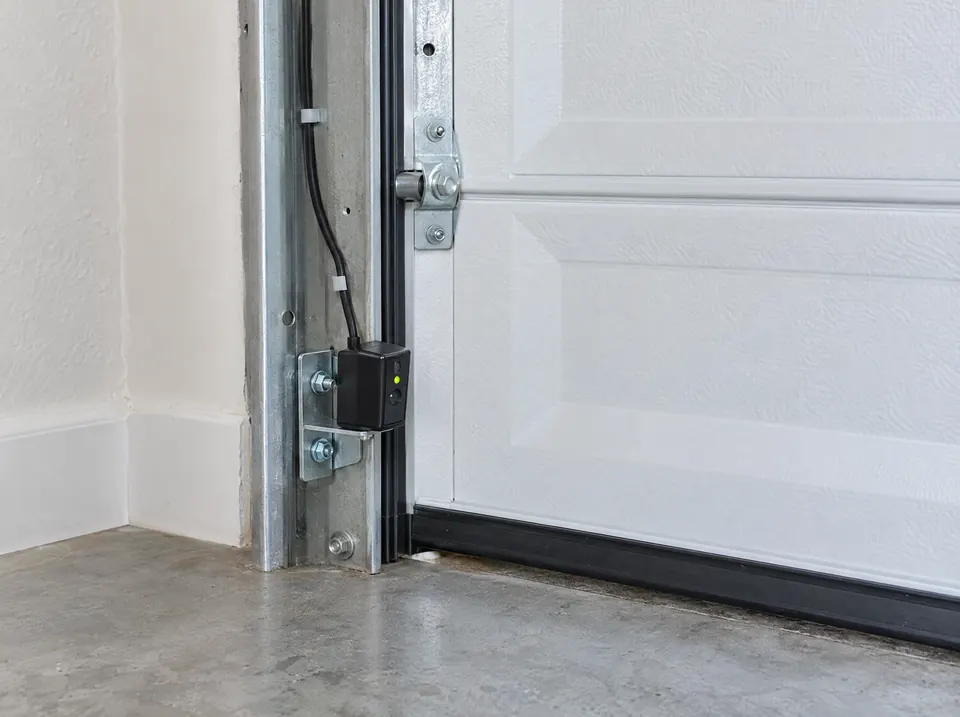
Garage door safety sensor mounted low on the track beside a closed white door
Safety sensors

Why the door reverses: the photo eyes near the floor

Most openers use a pair of safety sensors, often called photo eyes, mounted a few inches above the floor on each side of the door. One sends an invisible beam and the other receives it. If anything breaks that beam while the door is closing, the opener sends the door back up.

Many reversals trace back to these sensors. A bumped bracket can knock them out of line, dust or cobwebs can cloud a lens, and a damaged wire can cut the signal. On many models a blinking or unlit indicator on one sensor is the first clue. Wiping both lenses with a soft cloth is a safe first check.

Before blaming the motor

Door problem or opener problem?

A door problem

The opener only guides a door that is already balanced. If a spring is broken or a cable has slipped, the door itself is the problem, even though the opener is what seems to fail.

The door is the likely cause when it feels very heavy, hangs crooked or has left the track. Those call for spring, cable or track repair first.

Clue
Door is heavy or uneven
Opener behavior
Strains, stalls or reverses
Look at first
Springs, cables or track

An opener problem

When the door moves smoothly by hand and stays level, the fault is more likely in the opener, its sensors or its controls.

Typical opener faults include a worn drive gear, a failed circuit board, travel limits that have drifted and remotes that have lost their pairing.

Clue
Door balanced, opener acting up
Opener behavior
Hums, clicks or ignores commands
Look at first
Motor, drive, sensors, controls
How openers work

What to know about garage door opener repair

A residential opener moves the door with a motor and a drive. The drive type affects how loud the opener is and which parts tend to wear.

  1. Chain drive

    A metal chain pulls a trolley along a rail. It is common and durable but usually the loudest type, and a slack chain can slap against the rail.

  2. Belt drive

    A reinforced rubber belt takes the place of the chain. It runs quieter, which helps when a bedroom sits over or beside the garage.

  3. Screw drive

    A threaded steel rod turns to move the trolley. It has fewer moving parts, though it can be noisy and the rod needs to stay clean and lubricated.

  4. Jackshaft and direct drive

    A jackshaft unit mounts on the wall beside the door and turns the torsion bar. A direct-drive unit travels along a fixed chain. Both tend to run quietly.

Opener questions

Garage door opener FAQs

Why does my remote only work up close?

A weak battery is the usual cause. A damaged antenna on the motor unit, or interference from some LED bulbs in or near the opener, can also shorten the range.

The motor hums but nothing moves. What is it?

On many openers a hum with no movement points to a stripped drive gear or a failed capacitor. It can also mean the door is too heavy to lift, so the door should be ruled out first.

What if the door keeps reversing after I clean the sensors?

Look for anything in the beam's path, then check that both sensor lights are steady. If it still reverses, stop trying to force it closed. The reversal is either a safety feature doing its job or a fault that needs a proper look.

Opener acting up? Give us a call

Tell us what happens when you press the button, including any lights or sounds. Or email [email protected].

Call (954) 758-9013