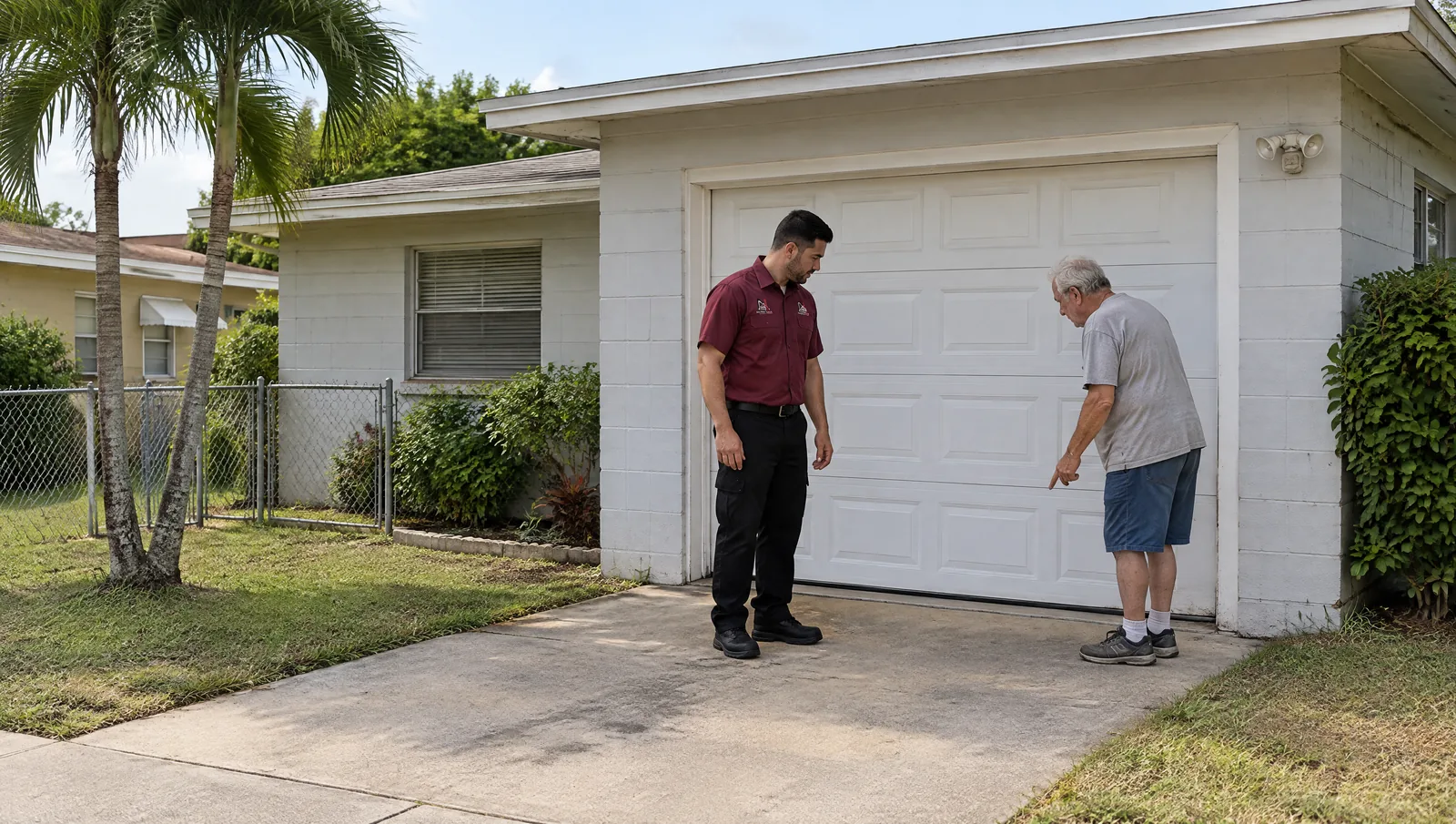
Garage door tune-ups and repairs
On an older West Park house the door may be newer than the frame it hangs in, or the other way round. Either way, mismatched parts make a door sag, rub the jamb or leave a gap at the floor. The repair might be as simple as new hinges and rollers, or it might mean resetting the track so the door runs straight. In West Park we also look for wood rot or soft framing where the track bolts on, since that can let the whole track shift.
Garage door repair
Spring replacement
Older garages, including some in West Park, may still use extension springs, the long coils that stretch along each side of the track. They should always have a safety cable running through the middle, because a spring that snaps without one can whip across the garage. Newer doors use a torsion spring on a bar above the opening. Whichever kind you have, the replacement springs are sized to your door's weight, and an extension system missing its safety cables gets them added.
Spring repair
Opener troubleshooting
When the motor in a West Park garage runs but the door doesn't move, the plastic drive gear inside the opener has often stripped. Other times the trolley has come unhooked from the door arm, or the chain has gone slack and is skipping. An opener old enough to predate auto-reverse sensors is worth a look for safety reasons alone. You'll be told plainly whether a repair makes sense or the unit has reached its end.
Opener repair
Cable repair
Extension spring doors in West Park use a cable and pulley on each side, while torsion doors wind their cables onto drums. Either way, a worn pulley or a frayed cable makes the door rise unevenly or lurch. If you see a cable hanging slack, or the door looks lopsided when it's open, leave it closed. Cables carry real load, so a West Park cable job is done with the tension released safely first.
Cable repair
Off-track door repair
Tracks on older West Park garages are sometimes fastened into framing that has dried out or rotted, and a loose bracket lets the track spread apart until a roller drops out. A bump from a car or a broken cable can do the same. Once the door is off track, it is unsafe to run. The rollers are put back, the track is aligned and firmly fixed into sound wood, and the cause is fixed so the door stays put.
Off-track repair
Swapping out an original door
West Park is mostly a city of detached houses, and its housing is old, with a median build year of 1961. In homes that age the garage may have been altered more than once, so the opening and its framing are measured and checked before a door is ordered. A new door here has to meet Broward wind-load requirements and carry product approval, and the work normally calls for a building permit. Done right, it adds storm resistance to houses built long before those rules existed.
Door installation
Fresh rollers on long-serving tracks
On older West Park garages the rollers can be as old as the door, and many humid summers leave them rusty and flat-spotted. A worn roller rattles in the track, grinds at the curve and slowly chews up the track edge. Bent stems and cracked wheels are a usual reason a door jerks or sticks partway. Replacing the rollers as a set, and checking the track brackets they ride on, is one of the simplest ways to make an aging door safe and smooth again.
Roller replacement
Coating an older garage slab
Concrete in West Park garages has had years to collect cracks, oil spots and the fine dust that rises from a bare slab. An epoxy floor coating covers all of that with a tough, glossy layer that is easy to mop and stands up to car tires. Preparation is the real work. The slab gets cleaned and ground or etched so the epoxy can grip, cracks are filled, and moisture coming up from the ground is tested, since inland heat and daily summer storms keep slabs damp.
Epoxy garage flooring