
A two-car steel door is far too heavy for most people to hold overhead, yet a working one moves with a light pull. The springs make that possible by storing energy as the door closes and giving it back as the door opens. Both spring types do the same job. They just store the energy in different ways, and that changes almost everything else about them.
Telling them apart in ten seconds
Stand inside the garage with the door closed and look up.
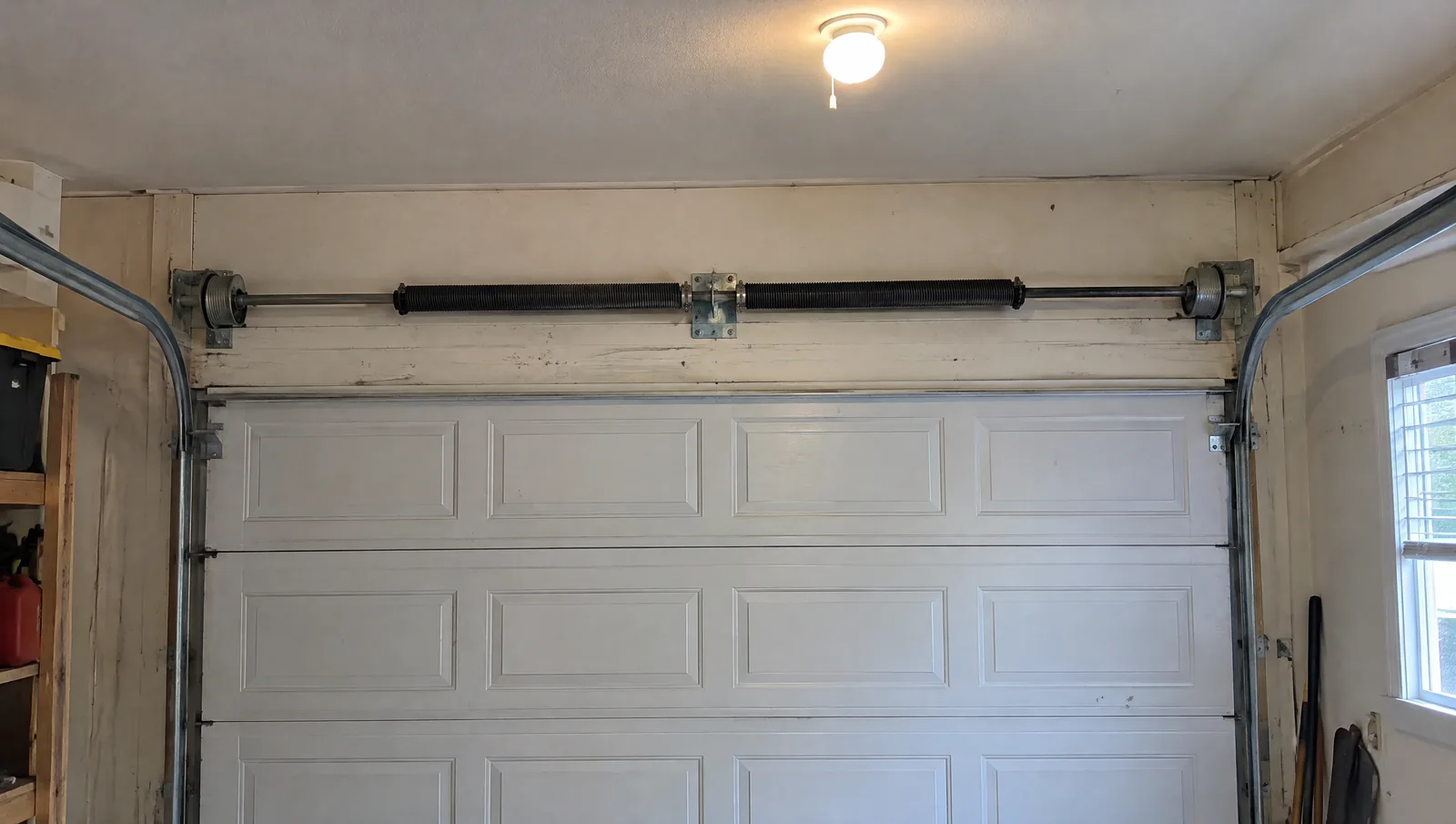
Torsion springs sit on a metal tube, called the shaft, mounted to the wall just above the door opening. You'll see one or two large coils on that shaft, often with a bracket in the middle, and a grooved drum at each end where the lift cables wind on.
Extension springs run front to back, parallel to the horizontal tracks near the ceiling, one on each side. They're attached to a pulley and a cable, and when the door closes you can see them stretched out long. There is no shaft across the top.
How torsion springs work
A torsion spring works by twisting. As the door comes down, the cables unwind from the drums and turn the shaft, which winds the springs tighter. Opening the door lets them unwind, turning the drums and reeling the cables back in. The force is applied evenly to both sides through the shaft, so the door tends to travel straight and smoothly.
Each spring is sized for the door's weight and height by its wire thickness, its inside diameter and its length. The springs are set with winding cones, and adding or removing turns is what balances the door. That job uses winding bars made for it, because the cones hold a large amount of twisting force.
How extension springs work
An extension spring works by stretching. When the door closes, each spring is pulled long and stores energy like a heavy rubber band. As the door opens, the springs contract and pull on cables that run over pulleys and down to the bottom corners of the door.
Because each side has its own spring, the two need to match closely or the door lifts crooked. A proper extension setup also has a safety cable threaded through the middle of each spring, anchored at both ends. Its only job is to catch the pieces if a spring breaks, so they don't whip across the garage.
How each type wears and fails
Both types are rated in cycles, one cycle being a full open and close, and both wear out eventually. How they fail is different. A torsion spring usually cracks in one spot and stays on the shaft, often with a loud bang. An extension spring can snap or a pulley and cable can fail. If the safety cable is missing, that is when broken parts get thrown.
Extension systems have more small moving parts that wear, including pulleys, cable ends and the hooks or clips that hold everything in place. Torsion systems have fewer, but their bearings and drums need to stay in good condition for the cables to wrap correctly.
Is one better?
For most double doors, torsion springs are the more common choice today because they balance the door evenly and tend to last longer under daily use. Extension springs remain common on lighter single doors and on garages where there is not enough room above the opening for a shaft. Neither type is wrong. What matters is that the springs are correctly sized for the door they carry.
Converting from extension to torsion is possible on many doors. It usually means new springs, a shaft, end bearing plates, drums and cables, so it is a larger job than a like-for-like replacement and needs enough headroom above the door.
What this means for homes in Cooper City
In Cooper City, most homes are single-family houses, and the median home was built in 1987. On homes of that age, the door may still run on its original spring system or on a later replacement, and it is common to find either type. Knowing which one you have makes the conversation with a technician much simpler, and it lets you compare quotes for the same work.
Before you call
Note which system you have and, for torsion doors, whether there are one or two springs. If one has broken, our article on how to tell a garage door spring is broken explains what to look for and what to avoid touching. Replacement for both types, including matching the springs to the door, is covered on our garage door spring repair page. NovaLift Garage Doors can be reached at (954) 758-9013.