
Most people find out about a broken garage door spring the same way. They press the remote on the way to work and the door does nothing, or it lifts a few inches, shudders and stops. The opener is usually fine. What failed is the part that does most of the lifting.
Springs counterbalance the weight of the door. With them working, a door that weighs as much as a person can be lifted with one hand. When one breaks, the full weight lands on the opener and on you, which is why it pays to recognise the signs early and stop.
The sound you probably heard
A torsion spring holds the most tension when the door is closed. When a worn spring finally cracks, that stored energy lets go in an instant, and it often sounds like a gunshot or a heavy object hitting the floor. Because it happens while the door is sitting still, many people hear the bang at night or while they're in another room and only connect it to the garage the next time they try to open the door.
If you heard a loud bang from the garage and the door now behaves differently, treat the spring as broken until someone has looked at it.
What to look for, from a distance
On a torsion system
Torsion springs sit on a metal shaft just above the top of the door. Stand back and look at the coils. A healthy spring is one tight, continuous coil. A broken one has a visible gap, usually an inch or two wide, where the wire separated. On doors with two springs, compare them side by side.
On an extension system
Extension springs run along the ceiling above each horizontal track. A broken one may hang loose, sag below the track or lie in two pieces. These springs should have a safety cable running through the middle, which is what keeps the broken pieces from flying across the garage.
Other clues
- A lift cable hanging loose beside the door, or coiled on the floor
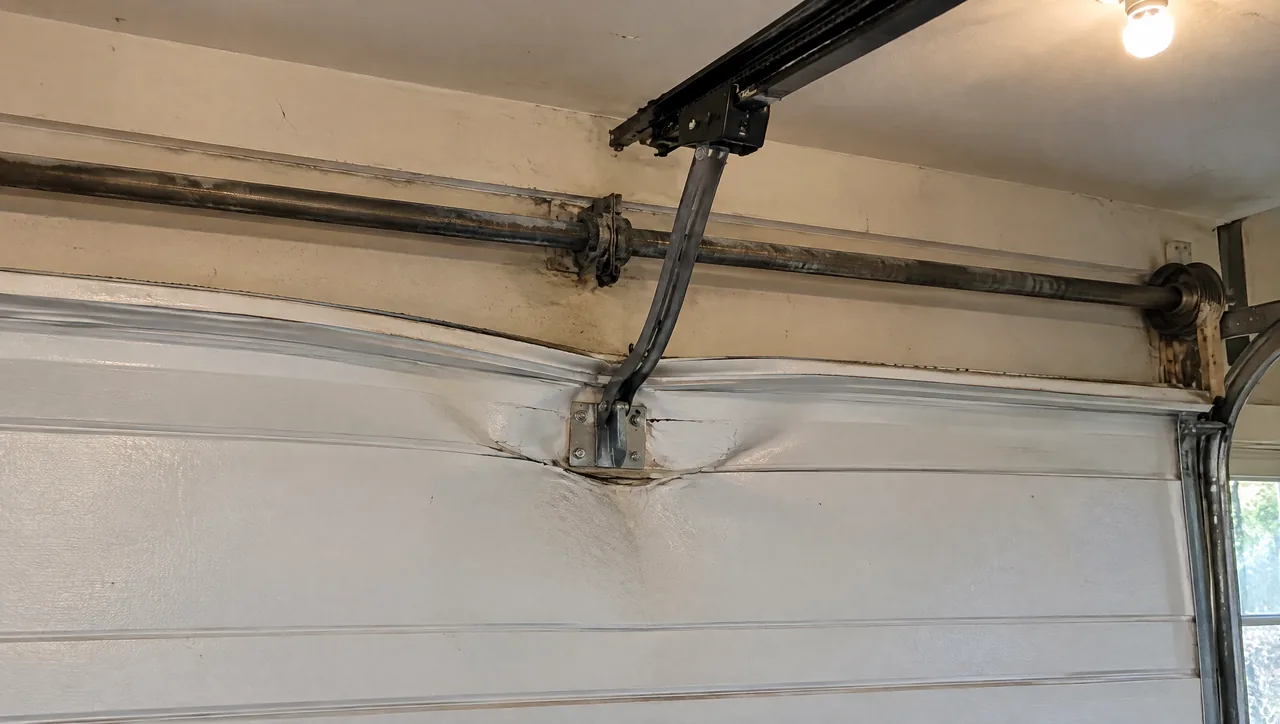
- The top section of the door bent or kinked where the opener tried to pull it
- The door sitting crooked, higher on one side than the other
How the door behaves
Even if you can't see the spring clearly, the door tells you a lot. A door with a broken spring usually does one of these things:
- It won't open at all, while the opener motor runs or hums
- It rises a few inches and stops, or reverses straight back down
- It goes up unevenly, with one side leading
- It feels extremely heavy if the opener has been disconnected
- It closes much faster than usual, almost dropping the last few feet
Modern openers are built to stop when they feel too much resistance, which is why a few inches and a stop is so common. That protection is helpful, but repeated attempts still strain the motor and gears.
What not to do
Don't keep pressing the button, and don't try to lift the door by hand to get a car out. Without the spring, the door is dead weight and can drop quickly once it leaves the floor. Don't touch the spring, the winding cones or the cable drums either. A torsion system that still has one working spring is under serious tension, and adjusting it without proper winding bars and training is how people get badly hurt.
The safest steps are simple. Unplug the opener, leave the door where it is, and keep people, pets and cars out of the doorway.
Why springs break
Springs are rated for a number of cycles, where one cycle is the door opening and closing once. A door used as the main way in and out of the house can rack up several cycles a day, so it reaches the end of its rated life sooner. Rust shortens that life further by pitting the wire. A spring that was the wrong size for the door, or a door that has drifted out of balance, wears out faster still.
Not sure which kind your door has? Our guide to extension springs vs torsion springs shows how to tell them apart. On a two-spring door, both springs have done the same work. When one breaks, the other is usually not far behind, which is why replacing them as a pair is often discussed during the repair.
What happens next
A spring replacement starts with confirming the spring type and checking the cables, drums and rollers for damage caused when it broke. The new spring is matched to the door's weight and height, wound or tensioned, and the door is balanced and tested with the opener. Our garage door spring repair page walks through the full process and typical national cost ranges.
NovaLift Garage Doors replaces broken springs in Hollywood and the surrounding cities, including homeowners in Plantation, where many of the 1980s and 1990s doors are reaching the end of their original springs. If you think yours has broken, call (954) 758-9013 before you touch the door.