
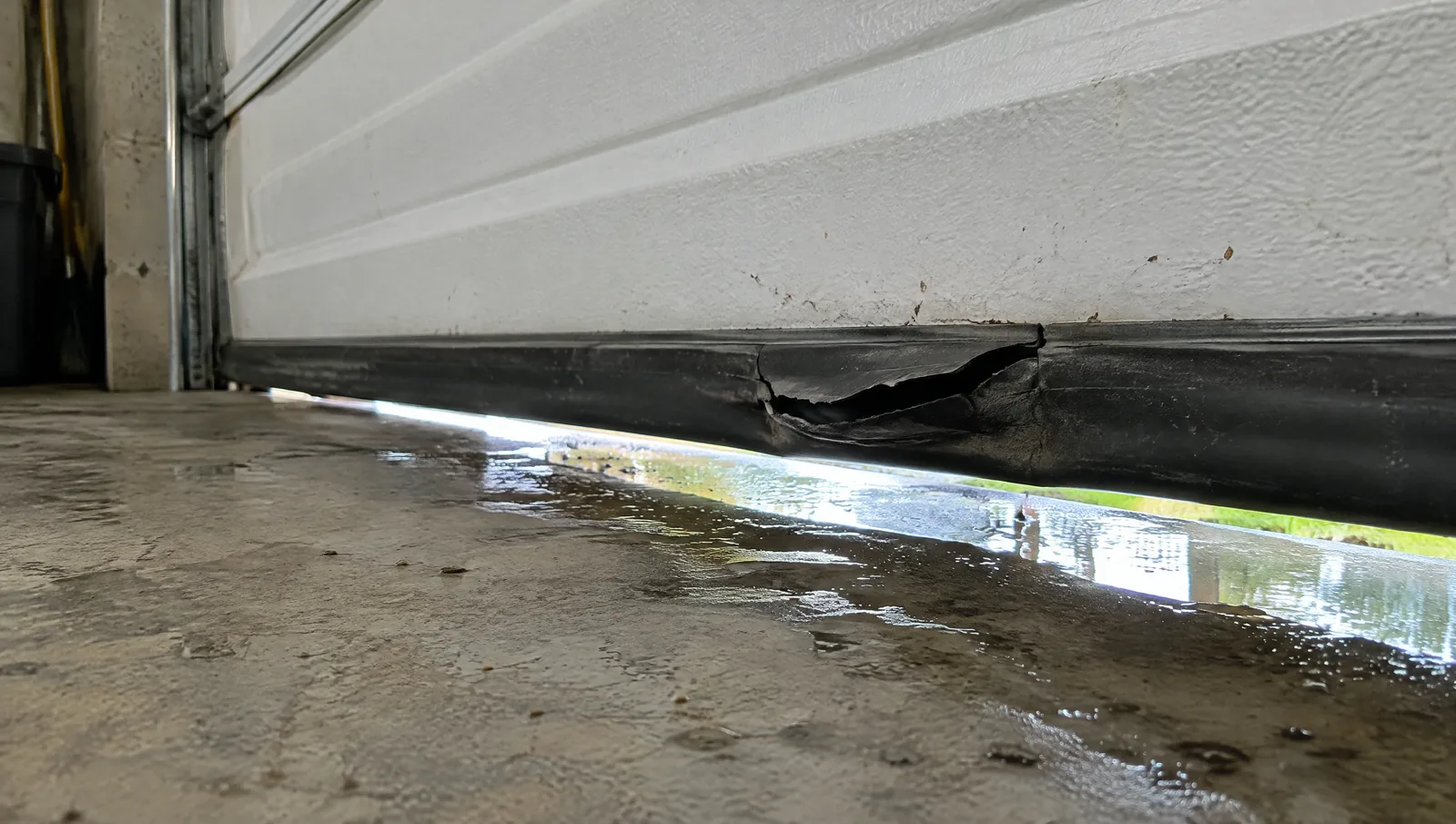
A garage door is the largest opening in most houses, and its bottom edge sits right at ground level where rainwater runs. The bottom seal, sometimes called the astragal, is a flexible strip that squashes against the concrete when the door closes. It fills the small dips and ridges in the slab so the door can seal even though the floor is never perfectly flat.
Rubber and vinyl don't last forever. Sun on the driveway side, heat inside the garage and thousands of closings all take their toll. The good news is that a seal is one of the simpler parts of a door to check and replace.
Signs the seal has had enough
Close the door on a bright afternoon, switch off the garage lights and look along the floor. A healthy seal shows little or no light. Other clues build up over time:
- A wet line or puddle just inside the door after a storm
- Leaves, sand and grass clippings collecting along the inside edge
- Ants, roaches or small lizards turning up in the garage more often
- Rubber that is cracked, brittle, torn or flattened into a hard strip
- Pieces of the seal hanging out of the door's bottom channel
Pests matter more than they seem. A garage often connects straight into the house, and anything that walks under the door can find its way inside from there.
When the gap isn't the seal's fault
Before buying a new seal, check how the door sits. A brand-new strip won't fix a door that isn't closing properly.
The door stops short
If the opener's close limit is set too high, the door stops an inch or two above the floor and the seal never touches it. The opener can usually be adjusted, but the force and travel settings work together, so the safety reverse has to be tested afterwards.
One side is higher than the other
A door with a light gap under one corner and a tight seal under the other is often hanging crooked. A stretched or slipping lift cable on one side is a common cause, and so is a cable that has jumped part of its drum. That is a job for garage door cable repair, not new rubber. Our article on why garage door cables fray and snap explains how that damage starts.
The slab has shifted
Concrete can settle or crack over the years, leaving a low spot the seal can't reach. A thicker bulb seal sometimes bridges it. A threshold strip glued to the floor is another option, though it must stay low enough not to trip anyone or catch tires.
The main types of bottom seal
Most steel sectional doors hold the seal in an aluminum retainer screwed to the bottom panel. The retainer has one or two slots, and the seal slides into them from the side. Common shapes include:
- Bulb or U-shaped seals, which form a hollow loop that compresses against the floor
- T-style seals, with flat edges that slide into a single-slot retainer
- Beaded seals, with a round edge that fits a two-slot retainer
Older wooden doors often have a strip nailed directly to the bottom edge instead. The retainer profile matters more than the brand. The safest way to match it is to take a short cut-off piece of the old seal along when shopping.
How a seal is replaced
On a retainer-style door, the work is mostly patience. The door is raised to about waist height and held there securely, with the opener unplugged. The old strip is pulled out of the end of the channel. If it is stuck, a little soapy water or silicone spray in the slot helps. The new seal slides in the same way, often with two people feeding it, and is trimmed at each end with a little extra length left to allow for shrinkage.
A retainer that is bent, corroded or missing screws won't grip a new seal. Replacing the retainer means working on the bottom section, and on many doors the bottom brackets that hold the lift cables are fixed to the same area. Those brackets are under spring tension, so leave them alone and have someone trained handle it.
Don't forget the sides and top
Water and insects also get in around the edges. Many doors have a vinyl weatherstrip along the frame, called stop molding, that the door closes against. If light shows down the sides, that strip may have pulled away or hardened. It is nailed or screwed to the jamb and can be reset or replaced on its own.
Keeping a seal in good shape
Sweep the threshold now and then so grit doesn't grind into the rubber. Wipe the seal with mild soap and water a couple of times a year, and keep oil and solvents off it. A seal that freezes to the floor is not a South Florida problem, but one that bakes onto hot concrete can tear when the door lifts, so look for sticking during the summer.
Rain is the real test here. Lauderdale Lakes is an inland city, and its rainy season runs from May 15 to October 15 with frequent afternoon storms. Summer heat bears down on rubber at the same time. Most of the city's homes were built in the 1970s, so many attached garages are on their second or third seal, and some are overdue. Our page on garage door repair in Lauderdale Lakes explains the services NovaLift Garage Doors offers in the city.
A seal can't stop standing floodwater, and no one should promise that. What it does is keep everyday rain, wind-blown debris and crawling visitors on the outside.
If the door won't close evenly, sits crooked or stops short of the floor, our garage door repair service starts by finding out why. Call (954) 758-9013.