
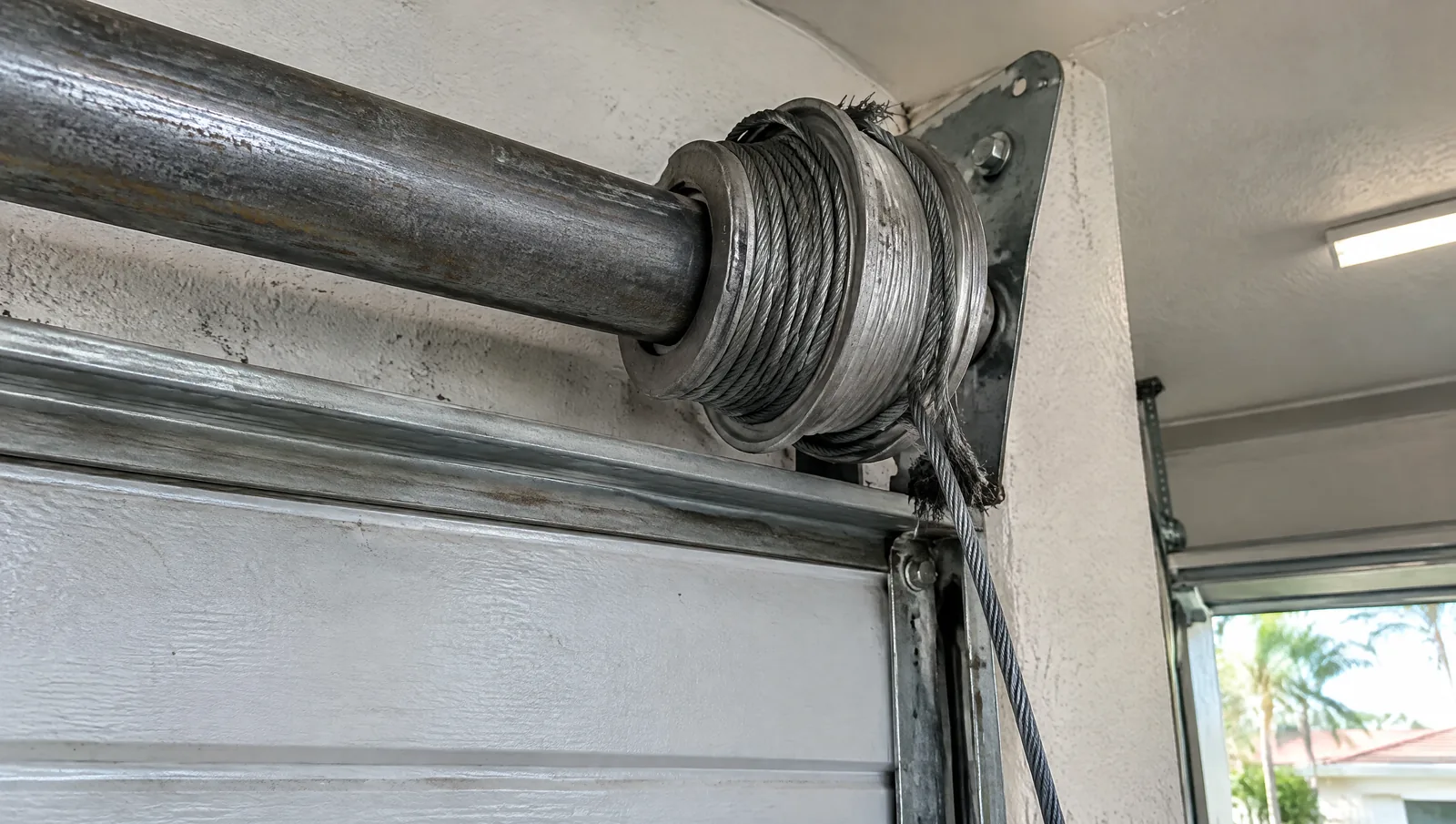
Most homeowners never look at their lift cables. They run up each side of the door, from a bracket near the bottom corner to a drum above the door or a pulley on the ceiling. When they work, nobody notices them. When one breaks, the door hangs crooked, drops on one side or jams halfway.
Knowing how cables wear helps you spot trouble while it is still a planned repair instead of a door stuck open with the car inside.
What the cables actually do
Springs store the energy that lifts the door. Cables are how that energy reaches the door. On a torsion system, the spring twists the shaft, the shaft turns the drums, and the drums wind the cables up as the door rises. On an extension system, the cable runs through pulleys so that stretching the springs pulls the door up.
Either way, each cable holds roughly half the weight of the door, all the time. Even with the door closed, the cable is tight. That constant tension is the reason cable problems are a safety issue and not just a nuisance.
Why cables fray
Rust from the inside out
A lift cable is many thin strands of galvanized steel wound together. Moisture works its way between the strands, and once the zinc coating wears through, the steel starts to rust. The outside may look only a little dull while the strands underneath are thinning. In humid places, and especially near salt water, this is the most common reason cables give out. Our article on how salt air corrodes garage door hardware explains that process in more depth.
Rubbing on something it shouldn't
A cable should run cleanly from the bottom bracket to the drum. If the track is a little out of line, a roller stem is bent or the bottom bracket has a sharp edge, the cable can rub with every cycle. Rubbing cuts strands one at a time. You often see the damage first as a shiny, flattened spot.
Worn or misaligned drums
The drum has grooves that guide the cable as it winds. If the drum has shifted along the shaft, or the grooves are worn, the cable can stack on itself or ride over the edge. That pinches and kinks the strands.
Slack and sudden loads
Cables are meant to stay tight. If a spring breaks, the door hits an obstruction or the opener keeps pushing down after the door is closed, a cable can go slack and jump off its drum. When the load comes back, it lands on a cable that is now sitting in the wrong place. Sudden jerks like that are hard on the strands.
Plain age
Every trip up and down bends the cable around the drum or pulley. Over years, the strands fatigue the same way a paper clip does when you bend it back and forth.
Warning signs to look for
You can check your cables from a few feet away with a flashlight. Look, don't touch.
- Loose strands sticking out like whiskers, usually near the bottom bracket or where the cable meets the drum
- Orange or brown rust along the cable, or rust stains on the bracket below it
- A cable that looks thinner or flattened in one spot
- One side of the door rising ahead of the other
- A cable that looks loose or has fallen off the drum after the door was closed
What happens when a cable snaps
When one cable breaks, the other side still holds its half of the weight. The door tips, wedges in the tracks and often comes off them. If it happens while the door is moving, the loose side can drop suddenly. A broken cable end can also whip as the tension releases.
Both cables are usually the same age and have done the same work. If one has failed, the other is rarely in good shape, so they are normally replaced as a pair.
Why this is not a do-it-yourself repair
The bottom bracket, where each cable attaches near the floor, is under spring tension. Loosening its bolts or unhooking the cable without first taking the tension off the spring can let the bracket fly or the door drop. Replacing a cable correctly means unwinding the spring with proper winding bars, fitting the new cable, setting it evenly on both drums, rewinding the spring and checking the door's balance.
What you can safely do is simple. Stop using the door, unplug the opener so nobody presses the button, and keep people and pets out of the doorway. If the door is stuck partway open, do not try to force it down by hand.
Keeping cables healthy
Have the cables looked at whenever the door is serviced or a spring is replaced. Ask that the drums are checked for position and wear at the same time. Any rubbing point should be fixed, not just the cable. A cable replaced without correcting what wore out the old one will fray the same way.
Our garage door cable repair page walks through how a cable job is done and the cost ranges involved. NovaLift Garage Doors handles cable repairs in Hollywood and nearby cities, including West Park. If you see frayed strands or a loose cable, call (954) 758-9013 before the door is used again.