
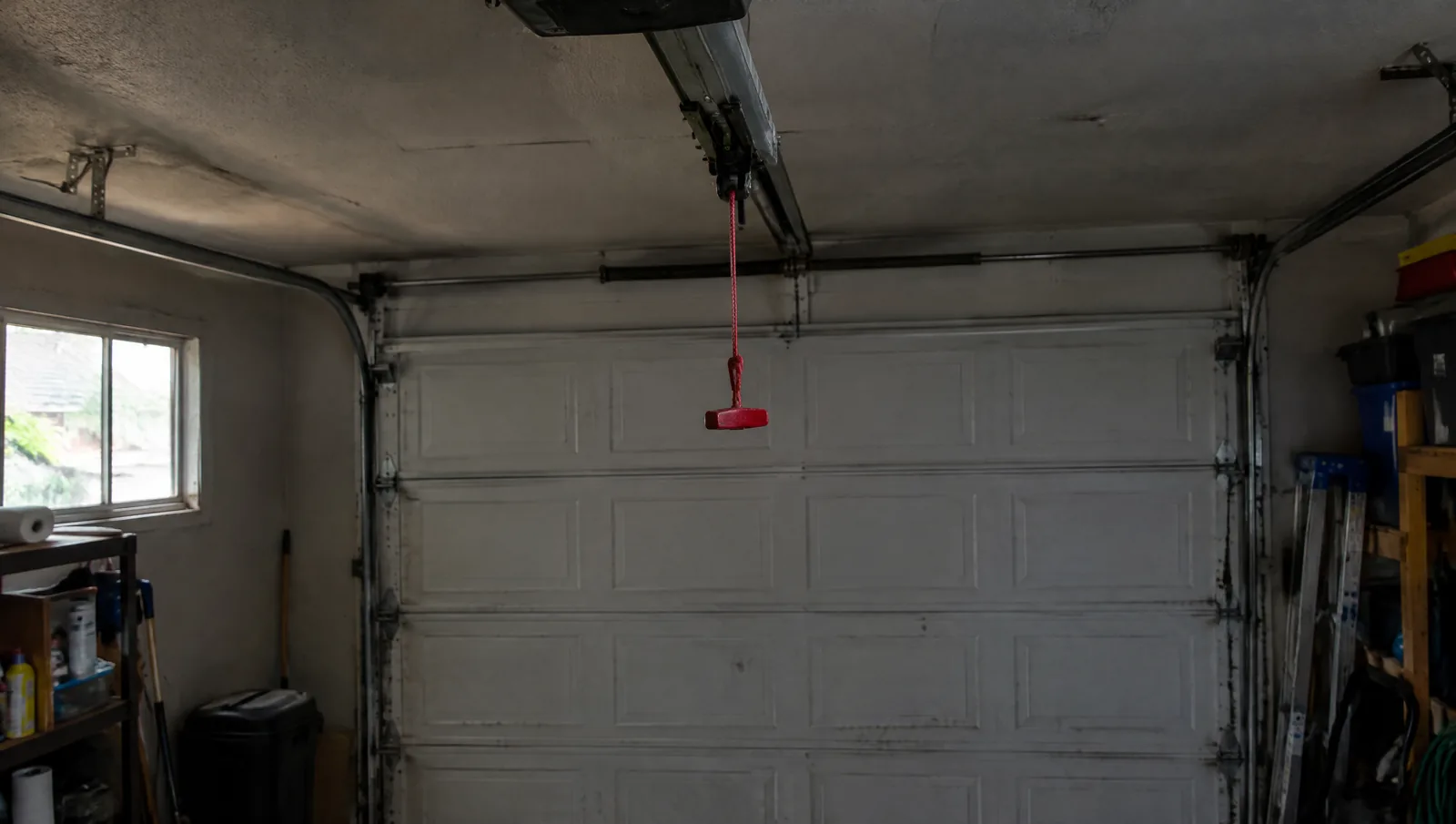
An electric opener is just a motor that pushes and pulls the door along a rail. The door is attached to that rail through a small carriage called the trolley. Pull the red cord and the trolley lets go, so the door rides freely on its own rollers and springs. That is the whole idea behind the manual release, and it is the reason a blackout doesn't have to trap your car inside.
Pulling the cord is easy. Knowing when it is safe to pull it, and what to do afterwards, is the part most people never get shown.
Before you touch the cord
The safest time to use the release is with the door fully closed. A closed door is resting on the floor, so nothing moves when the trolley disconnects. Pulling the cord on a door that is open or half open is a different story. If a spring or cable has failed, the door can come down hard the moment the opener stops holding it.
If the door is stuck open, keep everyone out from under it. Only pull the release when you can hold the door steady with your other hand, and be ready to step back. If it starts to drop quickly, let it go rather than trying to catch it.
Look up at the springs before you start. A torsion spring that shows a gap in its coil, or a cable hanging loose beside the door, means the door has lost its counterbalance. In that case don't try to lift it at all. Our article on how to tell a garage door spring is broken shows what to look for.
Opening the door by hand, step by step
- Unplug the opener or switch off its breaker. When power comes back mid-task, you don't want the motor starting while your hands are on the door.
- Check that nothing is blocking the door and that the outside lock, if your door has one, is unlocked.
- Pull the red handle straight down, toward the floor. On most openers you'll hear a click as the trolley releases. Pulling it sideways or toward the door can bend the arm.
- Grip the door by a handle or the bottom section. Keep your fingers away from the joints between panels, which close like a hinge as the door curves into the tracks.
- Lift steadily with your legs, not your back. A door with healthy springs should rise smoothly and feel close to weightless by the time it is halfway up.
- Raise it all the way, so it rests in the horizontal tracks rather than hovering at chest height.
What the weight is telling you
A balanced door is the best sign that the springs are doing their job. If the door feels very heavy, won't stay up on its own, or slides back down when you let go, the springs are tired or broken. Stop there and close it gently.
One side rising faster than the other points to a cable or drum problem, and grinding or binding as it moves can mean a bent track or worn rollers. Each of these needs attention before the opener is put back to work, because the motor will fight the same fault every time it runs.
Locking up while the power is out
With the trolley disconnected, the opener no longer holds the door closed. Many doors have a slide bolt or a T-handle lock on the inside that you can engage once the door is down. Use it if you plan to leave the house. Just remember to unlock it before reconnecting the opener, or the motor will try to lift a locked door.
If the garage is your only way in
Some homes have no door into the house from the garage. These often use an outside release, a small keyed lock on the top panel that lets you trip the trolley from the driveway. If you have one, find the key now, before you need it on a dark evening in the rain.
Reconnecting the opener
Once power returns, the trolley has to latch back onto the drive. Most openers handle this one of two ways:
- Automatic reconnect. Close the door by hand, plug the opener back in and press the wall button. The carriage travels along the rail and snaps into the trolley on its own.
- Manual reconnect. Some models have a lever on the trolley that must be pushed back, or a cord you pull toward the opener motor, to reset it.
After it reconnects, run the door through a full open and close. Then place a roll of paper towels or a small box in the doorway and close the door again. It should reverse when it touches the object or when something breaks the sensor beam near the floor. If it doesn't, leave the opener unplugged and get it checked.
If the trolley won't latch, the door opens partway and stops, or the motor hums without moving anything, the problem is in the opener rather than the door. Our garage door opener repair page covers those faults.
Storm season makes this worth practicing
South Florida's hurricane season runs from June 1 to November 30, and outages during strong storms are common. Don't open the door during high winds. A large open doorway lets wind push into the garage, which is the opposite of what you want while a storm is passing.
In Wilton Manors, much of the housing dates from the 1950s and 1970s, so plenty of homes have doors and openers that have been in service a long time. Older release handles can be stiff, or the cord may have been cut short and tied up out of reach. A quick test on a calm day, with the door closed, tells you whether yours still works. Our page on garage door repair in Wilton Manors covers what NovaLift Garage Doors offers homeowners there.
If the door is too heavy to lift, sits crooked or won't reconnect, call (954) 758-9013 and leave it closed until it has been looked at.