
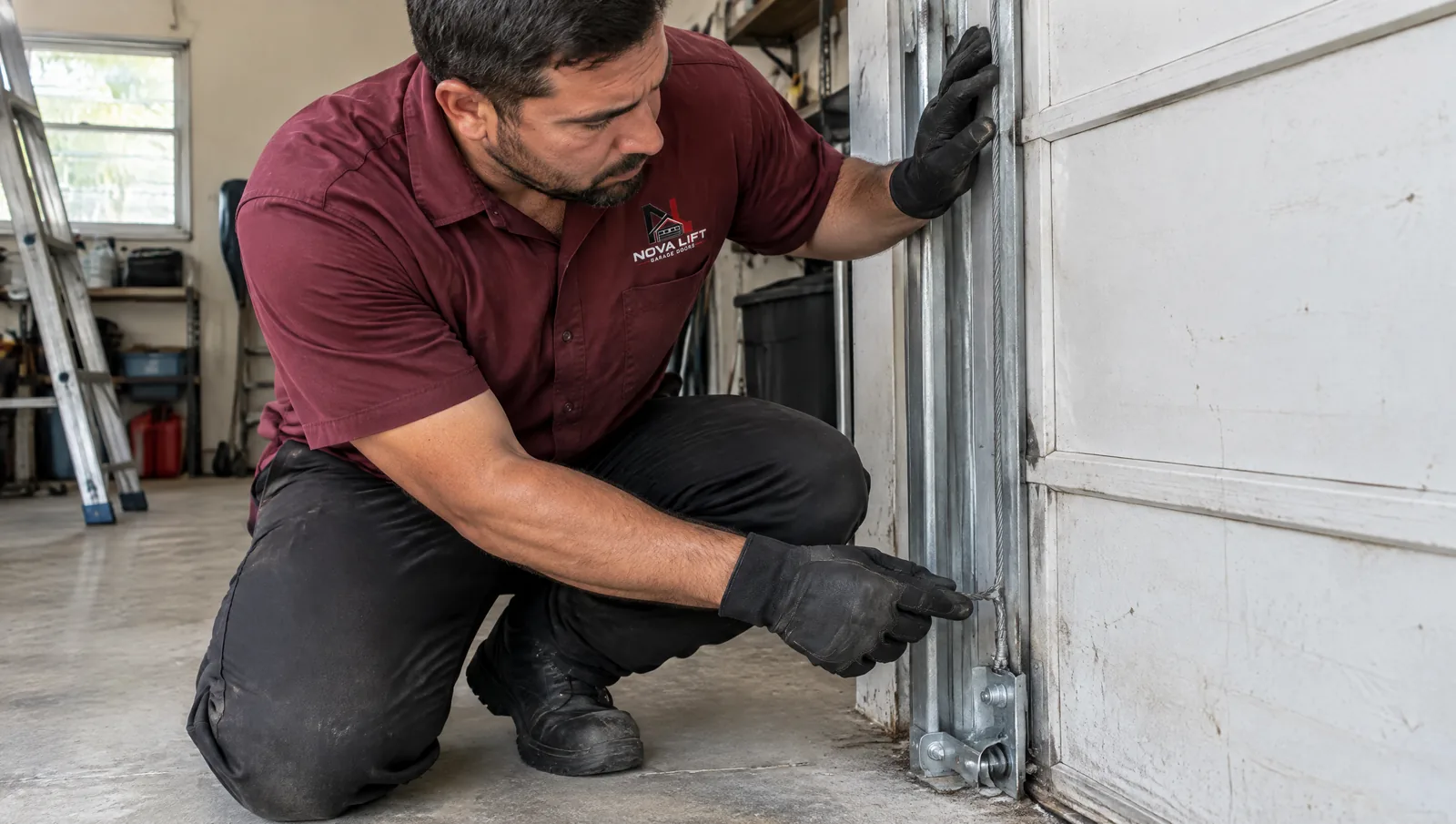
"Tune-up" can mean almost anything. For one company it is a squirt of spray on the hinges and a quick ride up and down. For another it is a full inspection of every moving part with small adjustments along the way. Knowing what belongs on the list helps you tell the two apart before you hand anyone your card.
A good tune-up has two goals. It keeps the door running smoothly and quietly, and it catches worn parts while they are still cheap to deal with. Nothing on the list below should take a technician long, but skipping steps is how a fraying cable gets missed until it snaps.
It starts with the balance test
The single most useful check takes about a minute. With the door closed, the technician pulls the opener's release cord so the door runs by hand. They lift it to roughly waist height and let go. A balanced door stays put or drifts slowly. One that drops or shoots upward has springs that no longer match its weight.
Balance matters because the opener is designed to guide the door, not to lift it. An out-of-balance door makes the motor work far harder on every cycle, and it is often the first sign that a spring is losing tension. If the door fails this test, the fix is a spring adjustment or replacement, which is work for someone with the right winding bars.
Springs, cables and drums
Next comes a close look at the counterbalance system. On a torsion setup the technician checks the coils for rust, for uneven spacing and for any gap that suggests a crack. They look at the winding cones and the center bearing plate for cracks or wobble.
The lift cables get special attention near the bottom brackets, where moisture collects and strands break first. Each cable should sit neatly in the grooves of its drum, with even tension on both sides. A cable that has jumped a groove or looks frayed is a repair, not a tune-up item, and a good technician will show it to you rather than just tell you about it.
Rollers, hinges and tracks
Every roller is checked for wear. Steel rollers with dry or rough bearings grind, and nylon rollers can crack or flatten. A roller that wobbles in its hinge usually means the hinge hole has worn oval. Hinges themselves can crack along the bend, especially on the top section where the opener arm pulls.
The tracks should be plumb and parallel, with no dents where a car bumper or storage bin has hit them. Mounting brackets are checked and tightened, since a door shakes its own fasteners loose over thousands of cycles. This is also when the technician looks for a bent top section, a common result of an opener pulling against a door that was binding.
The opener and its safety features
This is the part of a tune-up that protects people, so it should never be rushed. The technician tests the reversing feature by closing the door onto a solid object laid on the floor. The door should touch it and reverse. They also block the photo-eye beam during a close to confirm the door stops and goes back up.
Then they look at the opener itself: the rail mounting, the tension on the chain or belt, the travel limits that tell the motor where to stop, and the force setting. They finish by checking that the manual release cord works and hangs within reach. You need that cord the day the power goes out.
Lubrication and the bottom seal
Lubrication comes near the end, after everything has been inspected. Hinges, roller bearings, springs and the bearing plates get a light coat of a garage door lubricant. The tracks are wiped clean rather than greased. Our guide to lubricating a garage door explains which parts want oil and which should stay dry.
The rubber seal along the bottom edge is checked last. A seal that has gone hard, torn or flattened lets in rain, leaves and insects, and in a South Florida summer it can let water pool on the garage floor.
Why location changes the schedule
How often a door needs this attention depends on where it lives. In North Miami Beach, the eastern edge of the city sits along the Intracoastal Waterway, and salt spray near the coast eats at exposed metal hardware. The summer wet season keeps the air damp for months as well. Doors near the water may need their springs, cables and fasteners checked more often than doors far inland.
Much of the city's housing went up in the 1950s, 1960s and 1970s. On older homes, the door, springs and opener may each date from a different decade, so it pays to look at every component rather than assume they all aged together.
What a tune-up won't do
A tune-up keeps sound parts working. It can't bring back a spring that has lost its tension or a cable with broken strands. When the inspection turns up a worn part, you should get a clear explanation and a price before anything is replaced.
If the balance test or the spring check points to trouble, our garage door spring repair page explains what replacement involves. For anything else that turns up, from a noisy opener to a door that sticks, NovaLift Garage Doors handles garage door repair across Hollywood and the nearby cities. Call (954) 758-9013 to set up a visit.