
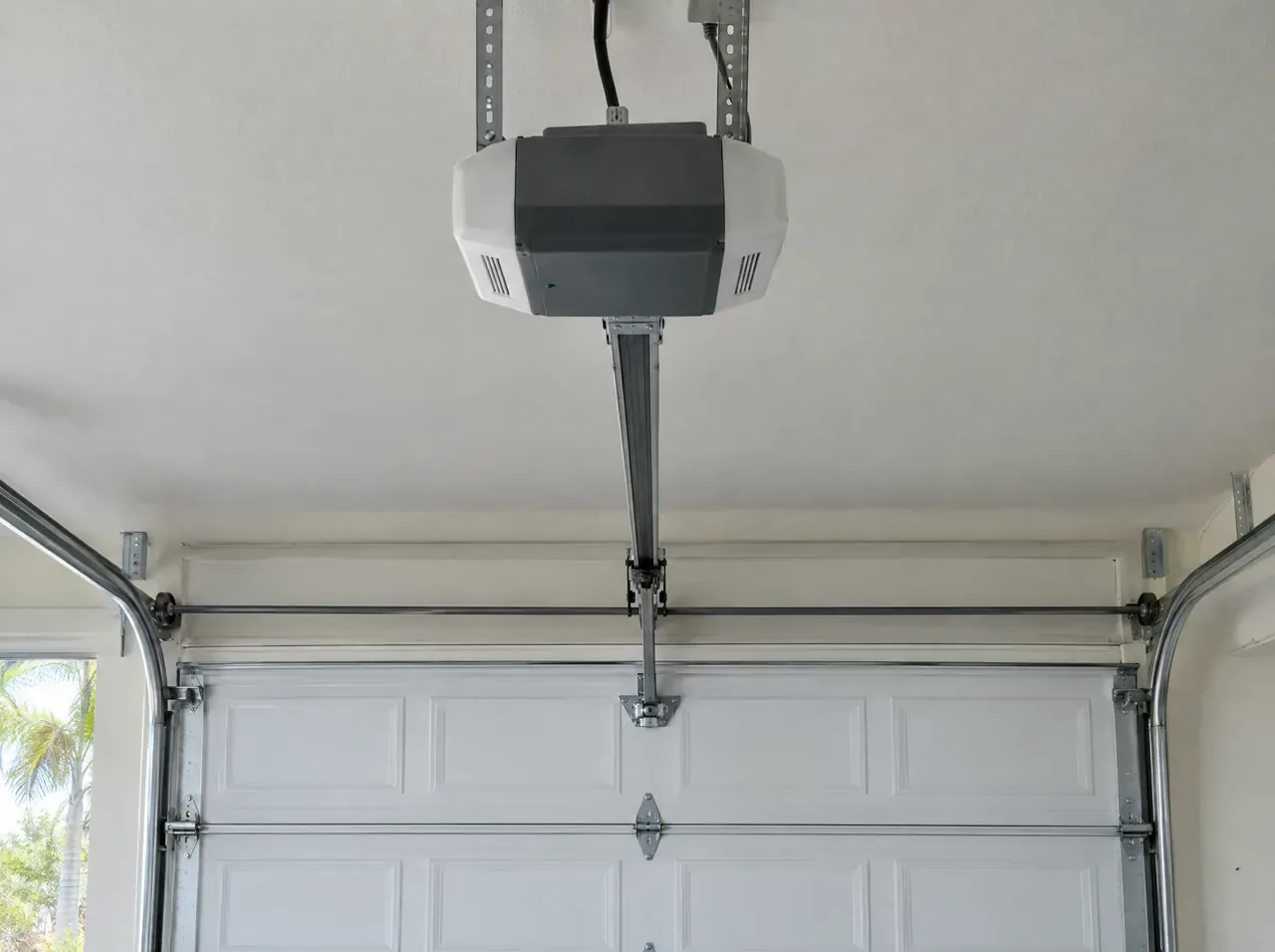
You press the wall button and hear a low, steady buzz from the ceiling. The light may come on. The door stays exactly where it is. After a few seconds the hum stops, or the opener clicks and gives up.
That hum is useful information. An opener that is completely silent has a power, remote or wiring problem. An opener whose motor spins freely while the door sits still has a drive problem, like a stripped gear or a disconnected trolley. A hum sits between the two. Electricity is reaching the motor, but the motor cannot start turning. Something is stopping it.
First, rule out the door
Before blaming the opener, find out whether the door itself can move. Many hums have nothing to do with the motor at all.
Is the door locked?
Some doors have a manual slide bolt or a T-handle lock on the inside. If someone slid that bolt into the track, the opener is pulling against a locked door. Look along both sides of the door at waist height and at the handle in the middle. This is the easiest fix there is, and it happens more often than people expect.
Is a spring broken?
The springs carry most of the door's weight. The opener only adds the last small push. When a spring breaks, the opener is suddenly asked to lift the whole door. Many units hum, strain and stop because they sense too much load. Look above the door for a gap in the coil of a torsion spring, or a loose or sagging extension spring along the ceiling. Our article on how to tell a garage door spring is broken covers the visual signs in detail.
If a spring looks broken, stop there. Leave the door closed and unplug the opener.
Is the door binding in the track?
A door that is crooked, has a roller out of the track, or has a bent section can jam hard enough that the opener cannot get it moving. If you see the door sitting at an angle or a roller outside the track, read what to do first when a garage door comes off its track before touching anything.
Then look at the opener
If the door is unlocked, the springs look whole and the door sits straight, the problem is more likely in the motor head. Two causes cover most of these cases.
A failing start capacitor
Many chain-drive and older belt-drive openers use an AC motor with a start capacitor. The capacitor gives the motor a short jolt to get it spinning. When the capacitor weakens, the motor gets power but not the extra kick, so it sits there humming. Sometimes giving the door a light nudge gets it going, which is a strong hint the capacitor is the culprit. A capacitor can swell, leak or look perfectly normal while failing. It also stores a charge, so it should only be tested by someone who knows how to discharge it.
A seized or burned motor
Motors wear out. Bearings dry up, windings overheat and insulation breaks down. A motor that has seized will hum under power and may get hot to the touch quickly. Openers usually have thermal protection that shuts them off for a while if they overheat, so a unit that hums, goes quiet, then works once after resting can be warning you of a motor near the end of its life.
Hum, grind or click: what each one means
- A hum with no movement. The motor has power but cannot turn. Think capacitor, seized motor, broken spring or a locked door.
- The motor runs but the door stays put. The motor turns freely and the drive does not follow. That points to a stripped drive gear, a broken chain or belt, or a trolley that has been released.
- A single click and nothing else. Usually a relay on the logic board or a power issue rather than the motor.
Listening carefully for a few seconds can save a lot of guessing. If you can, record a short video with sound before you call. It helps whoever comes out to arrive with the right parts.
What you can safely do
Press the button once or twice at most. Repeated attempts heat the motor and can turn a capacitor problem into a motor problem. Unplug the opener between tries.
Check the lock, look at the springs and cables from a distance, and make sure nothing is blocking the bottom of the door. If you need the car out and you are confident both springs are intact, you can pull the red emergency release cord with the door fully closed and test whether the door lifts easily by hand. A balanced door should feel light and stay put halfway up. If it feels heavy or wants to drop, close it gently and leave it.
Do not open the opener's cover, test the capacitor or adjust the force settings to make the door go. Turning up the force on an opener that is fighting a broken spring can bend the top section or strip the gears.
Repair or replace the opener?
A weak capacitor or a worn gear is a parts repair, and on many common models those parts are still easy to find. A burned motor is different. On an older unit, replacing the motor can approach the value of the whole opener, and that is the point where replacement is worth discussing. Age, part availability and whether the opener has modern safety sensors all feed into that choice.
Our garage door opener repair page explains how an opener is diagnosed, what the common repairs involve and the cost ranges that apply. NovaLift Garage Doors works on openers in Hollywood and nearby cities, including homes in North Miami Beach. If your opener hums and the door will not budge, call (954) 758-9013 and describe what you hear.